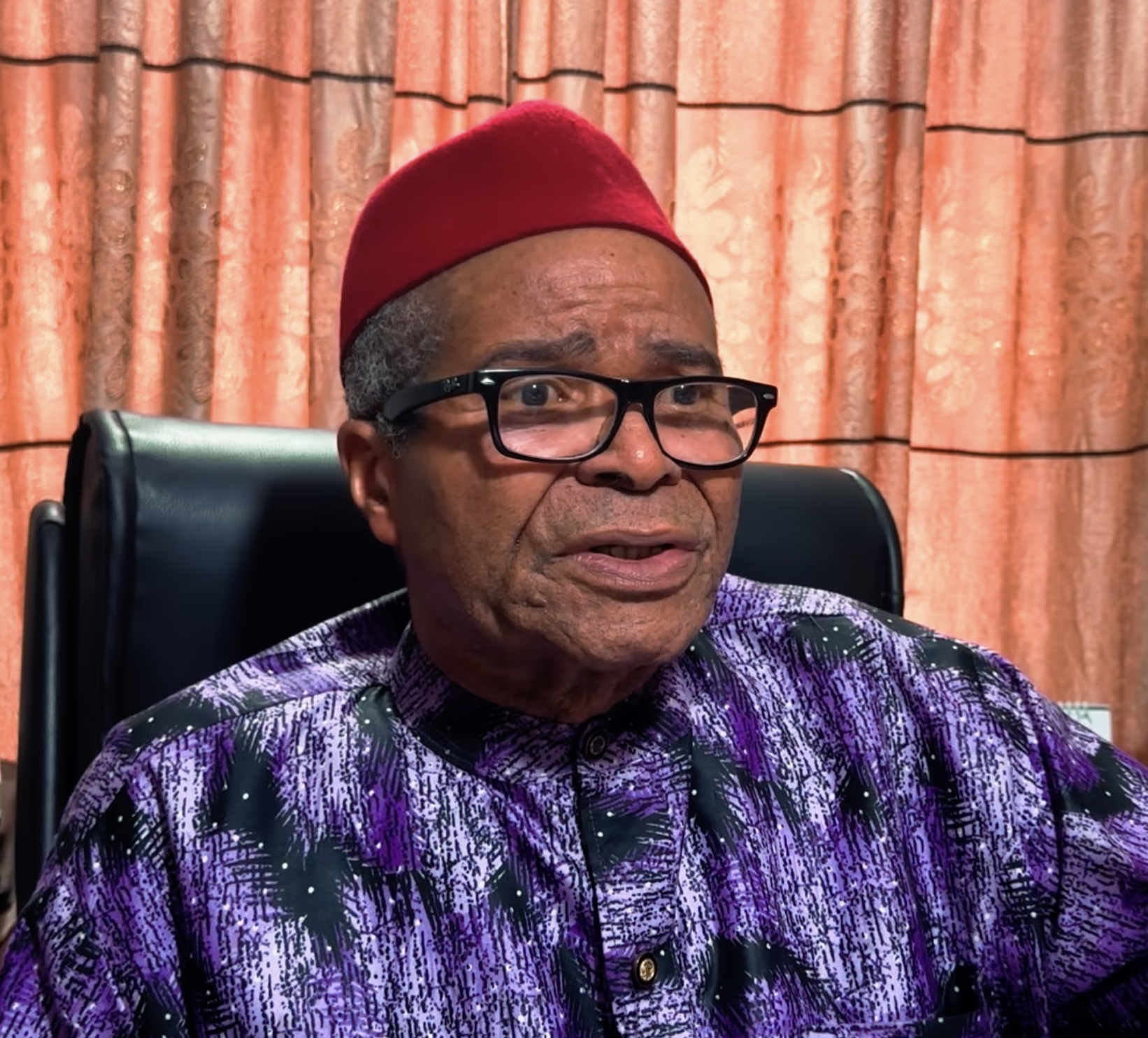
Mike Ahamba, SAN, is one of Nigeria's most prominent senior advocates and a former member of the House of Representatives. Called to the Nigerian Bar in 1975, he was appointed Senior Advocate of Nigeria on 20 July 1992 — one of only seven lawyers elevated that year. He led two consecutive presidential election petitions on behalf of then-candidate Muhammadu Buhari, in 2003 and 2007, and represented former Imo State Governor Emeka Ihedioha in the landmark 2019 governorship dispute before the Supreme Court. A twice-serving chairman of the Nigerian Bar Association, Owerri Branch, he was a founding member of the All Progressives Congress in Imo State and subsequently returned to the Peoples Democratic Party. He served in the House of Representatives during the Second Republic, elected on the National Party of Nigeria ticket. He had turned 80 the day before this recording.
Okay, let's begin with this question. At 79, you have lived through Nigeria's colonial era, civil war, military rule, and democratic dispensation. Looking back, what would you describe as the defining moment of your life? And what lessons have these experiences taught you about leadership, service, and resilience?
Well, I have to correct something. I'm now 80, not 79.
Oh.
Yesterday was my 80th birthday.
Once more — happy birthday to you, Chief.
Thank you. Defining moments of my life is difficult to really identify. I've had so many defining moments as I moved from one situation to the other. But I think the most memorable day is the day I was made a Senior Advocate of Nigeria, on the 20th day of July 1992. At that time, I was quite a young lawyer, and I felt highly privileged. I made a commitment to the journalist who interviewed me that day that I was going to dedicate it to service — to justice, and nothing more. Because, as I said that day, I was not the only good material. Just God's grace that I was selected. That time, it was only seven people all around, and I felt highly privileged to be in that group. So I dedicated it to service to justice at all times, and I've tried to keep it that way since then. That is my most defining moment: the moment I committed myself to apply what privilege God had given me to the service of justice and of God Almighty.
As one of Nigeria's foremost legal minds, how would you assess the state of legal practice and administration of justice in Nigeria today?
Well, when you have a crowd, it's difficult to control. The Council for Legal Education is allowing the legal profession to be overcrowded. I don't think they are seriously monitoring which universities can train lawyers and which ones don't. They just allow them to throw thousands of people into one profession in a year, without what I may call alternative employment facilities. It's not very good for the profession. The struggle is affecting the quality of practice. People go to court these days for something they don't even believe in. I, for example — no matter what you offer me — I won't go to court for something I don't believe in. You must convince me that what you're chasing is not simply an effort to get what you don't own without telling the truth.
Now let me tell you something people don't know. I was the person approached to do the June 12, 1993 annulment notification case. Arthur Nzeribe approached me, and I told him I wasn't going to do it. It was going to be a disservice to the nation, and it was going to cause trouble for a very long time. He told me I would be properly paid. I said, "I don't need the money." I would have been the person who did the case, but I rejected it. That was a year after I became a Senior Advocate of Nigeria. So I tell my colleagues: our profession is not a money-making profession, even though you can earn money from it. As I've defined in my book, there is a difference between making money and earning money. Making money is acquiring wealth without an input. If you make an input and you get money, that's earning money.
In law, there are three qualities that every lawyer should always hold together: the quality of honour, the quality of nobility, and the quality of learning. That is a lawyer. Once you allow yourself to be used to do a thing that does not qualify under any of these three, you are derailing. A lot of people are doing it now just to survive. So the quality of legal practice has dropped seriously. It was not as we saw it when we came in. When we saw our elders in court — when we saw the old Jerusalem of administration of justice in this country — those of us who saw that old Jerusalem were in tears. Just like Jeremiah was in tears when he came back to Jerusalem.
What reforms do you believe are necessary to strengthen the judiciary and restore public confidence in the justice system?
First of all, the quality of training of would-be judges must be improved. This question of every university producing lawyers is not right. Who are teaching them? The fact that you are a university does not mean you must have all faculties. Not all universities produce doctors. In this society, whether we like it or not, doctors and lawyers are ranked because they have special roles to play. The doctor has the duty of maintaining life. The lawyer has the duty of governing how you live that life.
Even in England, University of London does not make you a barrister. You have to go to an Inns of Court. If Cambridge University and London University will not produce lawyers straight, why should our own universities do it? Where did they learn that? It's not acceptable.
I don't know what is going on, but I think the teaching of ethics is no longer very serious in our universities. Ethics of the profession is very important for the lawyer. Today, you find junior lawyers jumping up to attack a Senior Advocate of Nigeria. In our days, we wouldn't do that. Being polite to a senior will not stop you from doing your case. You allow the senior to finish. When he sits down, the judge will not foreclose you. So the teaching of ethics has fallen, and that is why things are going wrong.
Because eventually, you find that the endpoint of solving things that have gone wrong is within the legal profession — the bench and the bar. And if that place goes wrong, where do you go? There is no alternative. The next thing is anarchy, and we are very close to anarchy. Let those in the DSS be listening to me. Let them come and ask me why I say we are very close to anarchy. I will tell them.
So the lawyer must know that he is a special breed. Even Christianity would not have been what it is today if our Lord Jesus Christ did not come back to involve St Paul — and St Paul happened to have been a lawyer. If you are coming into that profession, you must know that you are not coming there as a trader, not as a businessman, not as a politician. But you can play politics, and when you do, you bring that honour, nobility, and learning into it. I am a politician, but my politics is 30% of my life. The rest is law: 70% lawyer, 30% politician. I am not going to keep away from politics, because keeping away from politics creates opportunities for people who should not be there to take over. So what do I lose by being there? At least let it be said that somebody said this is not right.
Currently, there is something of a jostle for the appointment of a substantive Chief Judge in Imo State. Is this the tradition — that when a Chief Judge is to be appointed, lawyers break into camps canvassing for different interests? What do you make of it?
Good. It is not the tradition. Our first Chief Justice was Adetokunbo Ademola. Since his time, succession to that office has been in accordance with seniority. The same thing has happened in the Court of Appeal, in the Federal High Courts, in state high courts everywhere. And I want to say that during my second tenure as chairman of the Owerri Bar, the judges of Imo State met on their own and passed a resolution that they wanted the Chief Judge to be appointed on the basis of seniority. I still have copies of that resolution now. So when did they change?
In the last legal year, that was the topic of my address. I said: the office of Chief Judge of a state should not be contested for. It should be a question of succession. If a person is sitting and has not been indicted of any offence, and is the most senior, make him Chief Judge — and nobody will quarrel, because we are trained to respect seniority.
Anybody tampering with such a person is playing politics — and playing with fire. Because the result will be to split the bench and split the bar, which is not right. We cannot stand for that. We just met and passed a resolution which I have signed together with past chairmen of the Nigerian Bar Association, Owerri Branch, saying we are not in support of anything that will remove the most senior from the position.
The common argument is that the constitution does not say seniority alone — that the person must be unblemished, must have a clean record.
Very good. That is why I said: if a person is sitting and there is no blemish in that person's record, why do you remove him? That is all. If somebody has had petitions written against him for corruption or anything, you can act on that. But if somebody is there and nothing has been written against him or her, why do you remove that person? It then means you have a selfish interest in that office. You want somebody you can control. Maybe you cannot control that person. This job should be left as it is. I want it to be as it was when I came into it, so my younger ones will also enjoy what we enjoyed. There should be no personal interest in it at all. That is my position, and it will continue to be my position no matter what they decide.
You are not just a senior lawyer — you were a close friend of former President Muhammadu Buhari. He said publicly: "My chief lawyer was Mike Ahamba, a Roman Catholic Igbo man." How did a lawyer who became SAN at a relatively young age become close to a northerner from Daura who became head of state and then president?
I was one of his biggest enemies. When he came into ANPP, I was opposed to him. I was looking at his record. Even though the country was disciplined during his military era, you cannot have it all. During that period, Nigeria became disciplined with the War Against Indiscipline, which was fought tenaciously. But because it was done without reference or deference to the rule of law, it hurt me as a professional. So when he wanted to be president, I didn't like it. I said, "This man will not respect the rule of law."
But something happened. We went to Kebbi State for a function. Buhari was there. We started discussing the Kano disputes. He said that somebody came to him and said, "I will be loyal to you." And he told the person: "Don't be loyal to me, be loyal to the party. Not me — the party." That changed my mind. So I said, "I must see this man one-to-one." Sule Hamma arranged a meeting in Abuja. I went and met him. I said, "I want to ask you one thing. You have always supported autocratic governments. You believe in one-party rule. Why are you now contesting in a multi-party election?" He smiled and said, "Look, you're right. But I have walked the whole world, and all the countries running a one-party state have collapsed. Who would wish that type of collapse on his country?" That was when I changed.
I stopped opposing his candidature, but I didn't come close to him until after the election. One day Dr Okadigbo sent for me. He said, "Chief Ahamba, we want someone we can trust to do the petition against Obasanjo." I said, "All right. If you want me to come, I will come, but you have to pay me." He said, "Yes, we'll pay you." The idea of going to be the lawyer for a presidential election petition weighed on my mind. I said, "Can you pay me 25 million?" Okadigbo said, "We don't have that kind of money. I must confess to you." I said, "If that be the case, I won't charge fees, but you have to pay for my accommodation." And that's how I came into it for 2003. He paid my hotel bill at the Hilton for quite a long time. But I didn't charge fees.
The second petition, in 2007, he didn't pay my hotel bill either — but I decided to go and fight. What was my interest? I observed that certain things were creeping into the electoral process, and I felt that if nobody highlighted them to the knowledge of the public, they would become a cankerworm in the society. So I went there and did my best to showcase the whole thing, and I'm writing a book on it. Nigeria needs to know what happened, and I will tell them.
Carrying ballot boxes to go and stuff votes and bring them back started in the 2003 elections. Let anybody dispute me on that point. But that didn't bother me. I identified certain safeguard provisions of the Electoral Act and raised them in the petition. We lost — they said we lost. The Electoral Act was then amended, and all those safeguard provisions were removed. So the National Assembly is part of the problem.
In 2019, you represented the Right Honourable Emeka Ihedioha in court. Did you lose the case on merit or on procedure?
I didn't lose on merit. And everybody will judge me from my book. I don't see how I could have been held responsible for a thing that was supported by three Supreme Court authorities, as against the personal opinion of a tribunal. I will let the world see everything — quoted in full. I'll see whether it is right, in order to give a particular ruling, to recast a provision of the law. The law said "persons affected by the appeal." The court, in the judgment, replaced it with "all respondents," then struck out our appeal because we did not put all respondents — when the law says "persons affected by the appeal," with existing judgments of the Supreme Court on the very same point before the courts.
I am a respecter of the court and its hallowed level. But any time I am challenged to speak the truth about what went wrong there, I will speak it. You can judge for yourself: does "persons affected by the appeal" mean the same thing as "all respondents"? A Senior Advocate from Lagos told me: "If you don't write a book on your experience in election petition tribunals, you have done this nation a disservice." And I think he was right. I'm not going to die with that disservice.
Nigeria is currently grappling with economic hardship, rising inflation, and widespread poverty. In your view, what are the fundamental issues responsible for the country's economic challenges, and what difficult but necessary steps should the government take to reverse the trend?
I don't claim any expertise in economics, but I am a human being in a society, and I know what is right. Any government that does not think about the basic needs of the society is a failed government — whether it is my party or another party, I don't care. Dr M.I. Okpara developed the Eastern Region as the fastest-growing economy south of the Sahara before the war, with only palm oil. What is happening today?
There is insecurity everywhere, but there is a security fund for which governors and the president do not wish to give account. Where are they directing this security fund? Chief Rochas Okorocha once described it as "my security fund." I told him it was not his own. It is supposed to be used to encourage the police, the army, to put the necessary equipment in place to secure the society. But they use it for private ends, as if it's their personal money.
When the so-called herders were roaming the Middle Belt and burning yams, stopping people from going to the farm, I forecast a period of food shortage. A lot of food came from that part of the country. We allowed it to happen. I wrote an article in 2018 saying: "This is a forward team of an army that is coming behind. They're testing the ground." One of the national papers published it. But nobody cared, because they called it a herder-farmer crisis. I said it is not herder-farmer when a child sleeping in the father's room in the night is killed.
We have two sets of criminals in this country today. The kidnappers — they call them bandits — and the Boko Haram people. One has an economic undertone, the other has a religious undertone. Unless we face it this way, we are making a mistake. The bandits want money, and they are grabbing money and recruiting from the untrained youth who have been abandoned in the streets. The Boko Haram people say Western education is bad, and we are closing schools in their favour. Let those in charge know: this war will affect everybody eventually.
What is your position on state police as a solution to the security problem?
They say state police will solve the problem. I don't agree. State police will create another problem, and I know it's a very minority view. Let it be put on record that I said it. It's going to create an extra problem because governors are looking for their weapon against those who oppose their rule. They are looking for an official weapon. If you recruit police today, how long will it take to train them to face these people? Why don't you encourage those already there and use the facilities you already have? Encourage them, and they'll fight.
State police is not the solution to our problem. The current military formation, the current police formation — if well equipped and well motivated — can do this fight. Because the other day, when a general's sister was picked, was she not rescued? Ministers, were they not rescued? Let us tell ourselves the truth in this country. When the next election comes, people should vote in accordance with the truth.
You were among the founding members of the APC in Imo State in 2013, alongside Governor Rochas Okorocha and former Governor Achike Udenwa. What informed your decision to join the APC at its inception, and what eventually led to your departure and return to the PDP?
It was the CPC and the ACN that formed the APC. Tinubu was on the side of the ACN, and Buhari on the side of the CPC. Achike Udenwa was also in the ACN. When I left the CPC, I moved out of politics temporarily. Two people came to my hotel to talk to me. One was the present president of Nigeria, Ahmed Tinubu. He came to my hotel to talk to me, to come back to politics. El-Rufai also came. They asked me to come back because, they said, I had a very authentic voice and should not just retire like that. But I refused to go back to the CPC. I phoned Achike Udenwa and we joined the ACN. The ACN and CPC then met and formed the APC.
Why did I leave the APC? I was not happy with their constitution. It said that at a congress, the governor should be allowed to produce 60% of delegates. I said I would not accept that. You are going to run a 100-metre race, and you take one runner to the 60th point and put the others at the start, fire the gun, and call it a race? No. This is not politics. So we were fighting it from inside the party. Rochas Okorocha — whom I describe as a peripheral member of the APC, because he was of the APGA and personally defected to join us — started fighting some of us who had entered the APC through the ACN. When things started going the way I didn't like, I decided the best thing was to get out. So I resigned from the APC.
When I resigned, Jonathan started sending delegations for us to return, because I had been a member of PDP before joining APP and then ANPP. We agreed to come back. I am not going to leave the party for any other party. Never. Even if it is going to fail the next election, I'm going to fail it with them. I don't like this jumping from party to party. If everybody defects from PDP, one person will remain, and that person's name will be Mike Ahamba.
The debate over the political future of the Igbo people and their place in Nigeria's power equation remains intense. How do you assess the current political standing of the Southeast, and what strategy should Ndigbo adopt to achieve greater national integration and political relevance?
Forget about achieving greater national integration. Eventually, we shall get what we want. I am not prepared to support anybody so that he can take care of Igbo people. We are not strangers here. All we need to do is to send the right people to the centre. We don't. We send the richer people. And they may not be the right people. That is the problem.
The role money plays in politics in the Southeast — if it doesn't change, we will never send our first eleven. I remember a northerner, a former governor of Kaduna State, told me that my problem was where I come from. He said he knew I was a comfortable man, but not rich enough to win the elections I want to win in our place because I don't have what it takes to win here. In my face, he said that. And he was right. How do you come to a congress where people are paying out 1.7 million naira to a single voter? Where would Mike Ahamba get that kind of money? Even if I had it, I wouldn't spend it. Because if I spend it, I will need to recover it.
I earn money. I don't make money. I became financially stable in my first week after youth service. So money was not the issue. The issue was an avenue of service. And if you are going on an avenue of service, you cannot take money from just anywhere, because if you take money from someone, you have to honour that commitment. If I give you my word, I will keep it. If you give me money and say, when you get in there, you must give me this — I will not keep that bargain. And since I will not keep it, I won't take your money. Period.
Our people here must learn to send the right people, not the rich people. If you listen to the villages now, you'll hear: "Ah, that man has a lot of money, oh — he should run for governor." Not: "That man is very competent, oh." That is the problem.
As you celebrate your 80th birthday, what legacy would you like to be remembered for as a lawyer, statesman, and public intellectual? And what message would you leave for young lawyers, emerging political leaders, and Nigerians generally about building a more just and prosperous nation?
As far as I'm concerned, I am not interested in what you think about me now. I am interested in what people think about me when I am no longer here. I want to be remembered as a politician who worked for the people, a man of integrity, a principled lawyer who did not believe in corruption, who fought it even at his own expense. That's it. I don't want to be remembered as a very rich man. Nobody has been put in history for being rich. Check history, from the Middle Ages and beyond. Nobody. The people history remembers had nothing. Was Socrates a rich man? Was Aristotle a rich man? Was Obama a rich man before he became president?
I want to be remembered as somebody who stood for what he believed, even if it did not favour him personally. And I want our young people to stop waiting for the old to go. When I contested my first election, I contested against a retired principal, and I was only 32. I just came back from youth service in 1975, and 1979 was the election. I joined politics in 1978. I went to the House, and within the minority, another retired person wanted to be chief whip — and I still won and became chief whip at 33. I didn't wait. I didn't say: "Old men, go." No old man will go for you. If you want an old man to go, prove yourself that you are better. That is how Kennedy became president. That is how Obama became president.
Our Igbo people say: Nwata kwuo aka, e ruo okenye rie nri. Let our young people prove themselves by doing small things in their environment. Let people have confidence in you. Don't sit back and say, "These old people don't want us." They won't clear the way for you. Trump is the same age as me. He is now President of America. America is as big as Africa. How old was Biden when he was in office? A 92-year-old was prime minister of Malaysia, to which our people go every time. Young people: prove yourself. Go and earn it.
Thank you very much, sir.
You're welcome.